
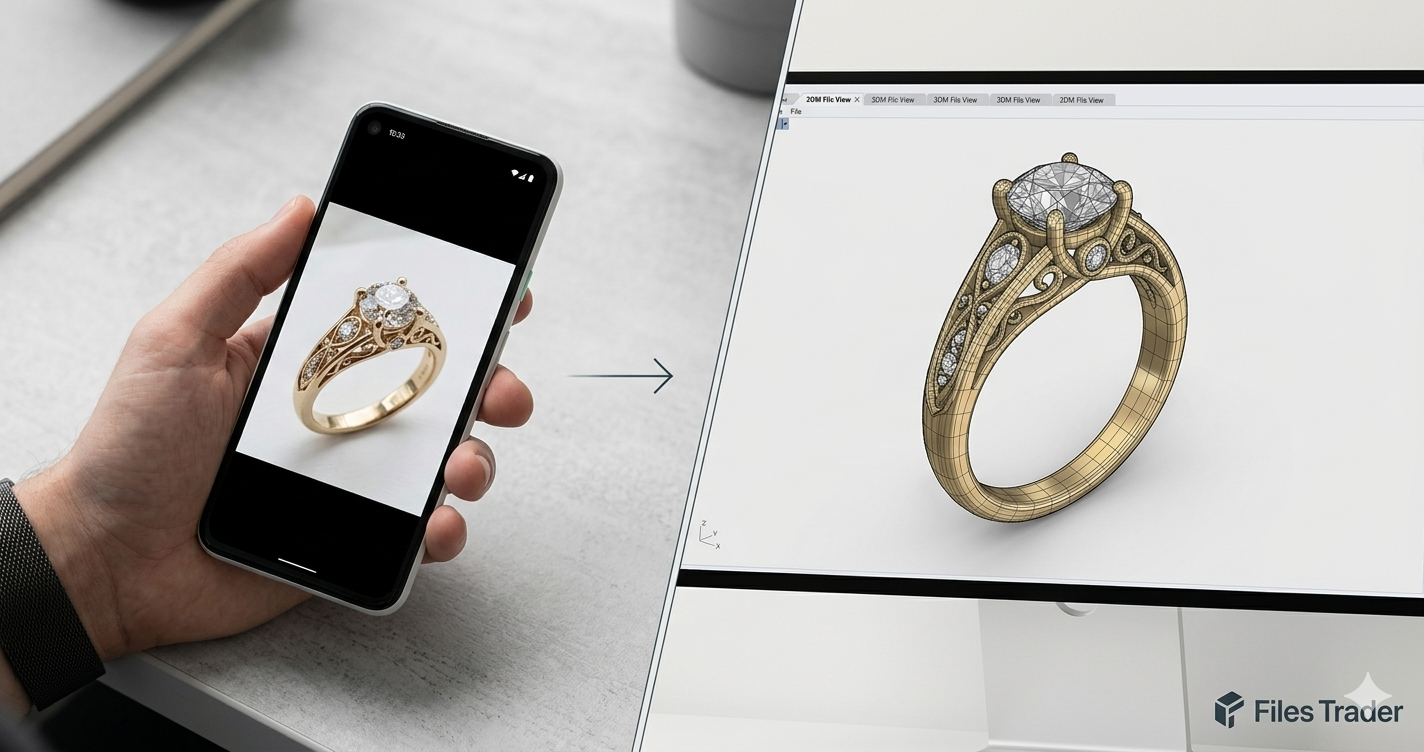
You have a piece of jewelry sitting in front of you. Maybe it is a ring that belonged to your grandmother. Maybe it is a pendant design you sketched on paper. Maybe a client handed you a photo from Instagram and said, “I want something exactly like this.”
Whatever the starting point, the result you need is the same: a precise 3DM or STL file that a 3D printer can read, a casting house can use, and a finished piece of metal can come from.
That is exactly what we do at Files Trader. You send us an image. We build the 3D file. You receive it within 24 to 48 hours, ready to print and cast.
This article explains the whole process in plain detail — what kinds of images work, what we deliver, how long it takes, and what you should do once you have the file. If you are simply looking for ready-made designs, you can also browse our ready-made STL files and download them immediately. But if you want something built specifically from your reference, read on.
Why This Service Exists
There is a gap in the jewelry industry that most people do not talk about openly.
On one side, you have jewelers, workshop owners, and individual buyers who have very specific ideas — they know exactly what they want, and they can point to a reference image in seconds. On the other side, professional CAD design services charge high prices, require long brief documents, have slow turnaround times, and often communicate in technical language that does not suit someone who just wants a ring made.
We built our custom design service to fill that gap. No lengthy briefs. No confusing back-and-forth. You send a clear image, we ask any necessary clarifying questions, and we deliver a production-ready 3D file at a price that makes sense for small workshops and individual jewelers.
The service works entirely through WhatsApp and email — channels you already use every day — so there is no new software to learn and no complicated ordering system to navigate.
What Types of Images Work Best
The most common question we get is: “Is my photo good enough?”
In most cases, yes. Here is what we can work with:
Photographs of existing jewelry are the most reliable reference. A clear photo taken in good natural light, showing the piece straight on or at a slight angle, gives us everything we need to understand proportions, stone settings, shank thickness, and surface detailing. You do not need a professional camera — a modern smartphone in good light is perfectly fine. If the piece has intricate detail on the side or back, send a second photo from that angle.
Hand-drawn sketches work very well too, even rough ones. Sketches are useful when you want to create something new that does not exist yet. Include a note with measurements if you have them — ring size, approximate width, stone size — but even without measurements we can produce a sensible starting point and adjust from there.
Screenshots and reference images from Instagram, Pinterest, jeweler websites, or product catalogues are completely acceptable as a reference point. We will replicate the design concept and proportions without copying proprietary designs — the final file is built fresh in CAD software.
Multiple images combined are welcome when a client wants elements from different pieces — for example, the shank profile from one ring combined with the setting style from another. Just label them clearly so we understand which element comes from which image.
What does not work well: extremely blurry photos taken in dark conditions, images where the jewelry is partially hidden by hands or packaging, and very low-resolution screenshots where fine detail is lost. If you are unsure, send what you have and we will tell you immediately whether it is sufficient or whether a better angle would help.
What Types of Jewelry Can You Send Us?
We work across all jewelry categories. The most common requests we receive are:
Rings are the highest volume request. Ladies solitaire rings, gents bands, couple rings, cocktail rings, signet rings, Islamic rings — all of these are well within our standard scope. You can see the range of designs we already produce in our ladies ring collection and gents ring designs to understand the level of detail we work at.
Pendants and necklace charms are the second most popular category. Name pendants, religious symbols, animal designs, abstract shapes, logo pendants — we handle all of these. Pendants with fine open-work or cutout designs require slightly more time to model correctly, but the results are precise.
Earrings including studs, hoops, drops, and chandelier designs. Pair matching is straightforward since we model one piece and mirror it digitally.
Bracelets and bangles including solid bangles, link-style designs, and cuff bracelets with surface engraving or stone settings.
Hip hop and iced-out designs are a growing part of what we do. Iced-out pendants, Cuban link-style rings, and gents bands with heavy pavé settings are all achievable. If you work in this market, take a look at our hip hop jewelry files for an idea of the styles we already have ready-made.
Custom corporate and logo pieces — company logo pendants, brand emblems in 3D, commemorative pieces — are handled on a case-by-case basis depending on complexity.
The Step-by-Step Process
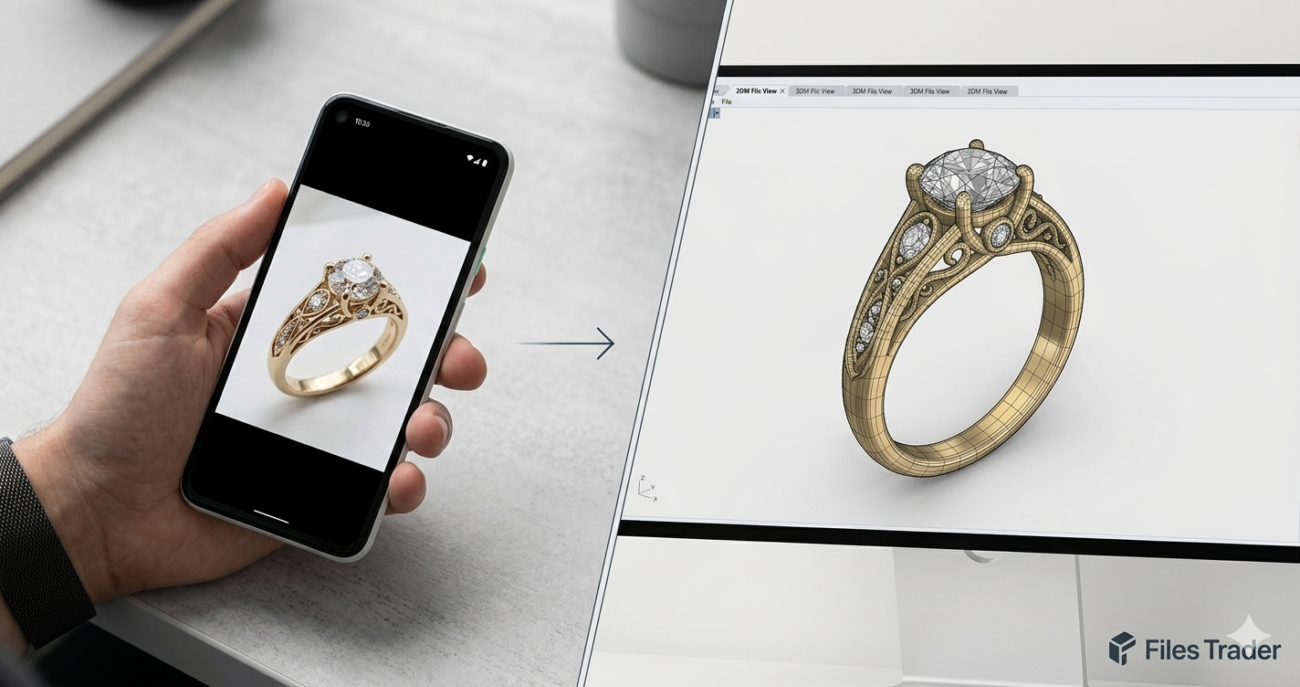
Here is exactly what happens from the moment you contact us to the moment the file lands in your inbox.
Step 1 — Send your image Contact us with your reference image through WhatsApp or email. Include any measurements or notes you have about size, metal type (for wall thickness optimization), stone sizes if relevant, and any specific details you want emphasized or simplified.
Step 2 — We review and confirm Within a few hours of receiving your image, we review it and confirm whether we have everything we need. If something is unclear — a measurement is missing, an angle is obscured — we ask one specific question at this stage. We do not send you a list of twenty questions. One question, if needed.
Step 3 — Modeling begins Once confirmed, our CAD designer starts building the file in Rhinoceros 3D. The model is built as a NURBS solid, which means it is geometrically accurate, dimensionally correct, and fully suited for casting and 3D printing.
Step 4 — Preview render sent to you Before we finalize any file, we send you a photorealistic render of the model from two or three angles. This is your chance to review and request adjustments. Most orders need one small tweak at this stage — a slight change in thickness, a stone size adjustment, a surface finish change. Two rounds of revision are included in the standard price.
Step 5 — Files delivered Once you approve the render, we deliver the final files. By default we provide both the 3DM (editable Rhino file) and the STL (print-ready file). The STL is pre-checked for mesh errors and is watertight, meaning it will go directly to your printer or casting house without additional repair.
Total turnaround: 24 to 48 hours for standard requests. Complex designs with heavy surface detail or intricate stone layouts may take up to 72 hours, and we will tell you upfront if that applies to your order.
From 3D File to Finished Metal Piece
Once you have the file, the path to a finished piece is straightforward.
You can send the STL directly to any casting service or 3D printing bureau. If you have your own resin printer, you can print it yourself — the STL is optimized for jewelry-grade resin printers running layer heights between 25 and 50 microns.
For those who want us to handle the full production chain, our castable wax model printing service takes your approved design and produces a high-quality wax or castable resin master, ready to go directly to your casting house. This removes the need for you to own or operate a printer at all.
The 3DM file, because it is fully editable in Rhino, can also be resized for different ring sizes, adjusted for different stone dimensions, or used as the basis for a whole product range. Many of our customers place one custom order, take the 3DM file, and use it as a starting template for dozens of variations.
What You Receive and What It Costs
Every custom order includes the following as standard:
The 3DM file (Rhinoceros format, editable), the STL file (watertight, print-ready), a set of photorealistic preview renders showing the piece from multiple angles, and two rounds of revision if adjustments are needed after the preview.
Pricing varies depending on the complexity of the design. Simple bands and solitaire rings sit at the lower end. Complex iced-out pendants with multiple stone layouts or fine engraving sit at the higher end. Contact us with your image for a quote — most quotes are returned within two hours.
Not Sure Yet? Start Here
If you are new to 3D jewelry files and want to understand what a finished file looks like before committing to a custom order, the best way is to download one of our free sample files and open it in a free viewer like Meshmixer or simply send it to a printing bureau for a test run.
Once you have held a printed piece from one of our files, the quality speaks for itself.
Send Your Image Today
The process is simple. Take a photo of your jewelry, sketch, or reference. Send it to us on WhatsApp or by email. Within 24 to 48 hours you will have a production-ready 3D file in your hands, built precisely from your reference, ready to print and cast.
Contact us on WhatsApp to send your image and get a free quote. No lengthy forms, no commitments, no complicated process. Just your image and a fast, professional result.
If you want to explore what we already have in stock before commissioning something custom, the complete jewelry CAD catalogue is the quickest way to see the full range of ready-made designs across all categories.
Files Trader — custom jewelry 3D modeling from your image, worldwide, 24–48 hour delivery.