
Custom Jewelry 3D Modeling from Photo — Turn Any Reference Image Into a Production-Ready File
There is a request that comes up in every jewelry business, sooner or later. A client pulls out their phone, shows you a photo — maybe a ring they saw on Pinterest, a piece a family member owns, a design from a catalogue they photographed in a store — and they say: “I want something exactly like this.”
For a jeweler working with traditional methods, this moment can be complicated. Hand-carving a wax model from a photo reference requires exceptional skill, significant time, and still produces results that depend heavily on the carver’s interpretation. The margin for error is real, and the cost of a failed casting is felt directly.
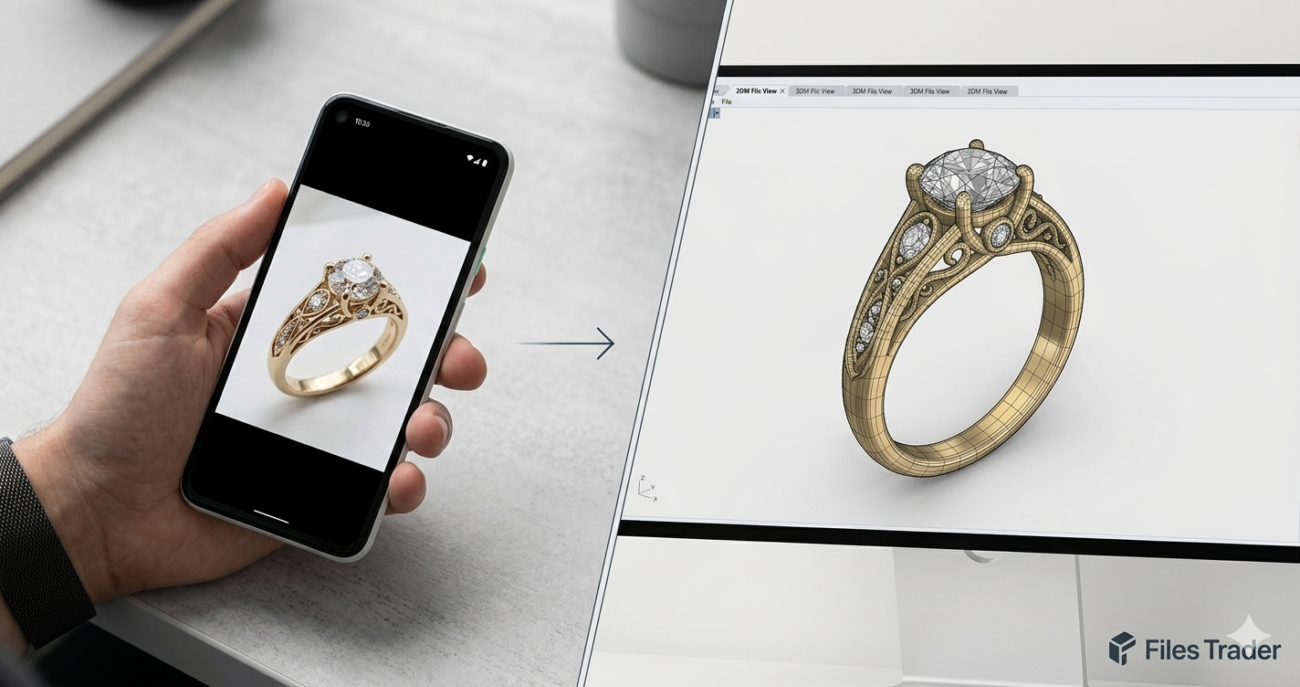
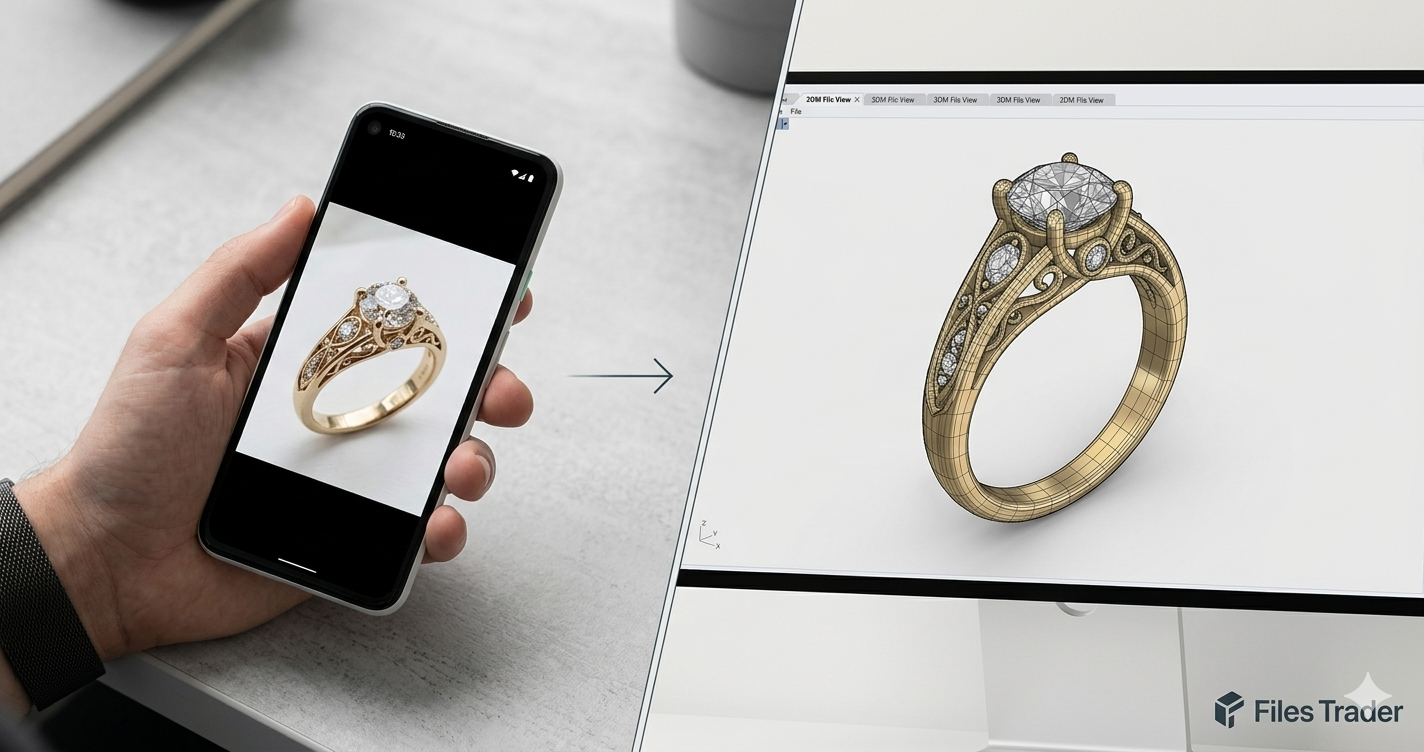
Custom jewelry 3D modeling from a photo removes that uncertainty entirely. The reference image goes to a CAD designer, who builds a precise digital model in Rhinoceros 3D based on what they can see — proportions, setting style, shank profile, surface finish. The result is a 3DM and STL file that matches the reference closely, can be reviewed in a photorealistic render before a single gram of metal is committed, and can be adjusted without starting over.
At Files Trader, this is one of our core services. You send the photo. We build the model. You receive both the 3DM and STL files, usually within 24 to 48 hours.
This guide explains exactly how the process works, what kinds of photos work best, what the files are used for once you have them, and who benefits most from this type of service.
How Custom Jewelry 3D Modeling from a Photo Actually Works
The process is more straightforward than most people expect, and it starts with a conversation rather than a lengthy brief.
You send a reference photo. This can be a photograph of an existing piece, a screenshot from Instagram or Pinterest, an image from a jeweler’s catalogue, or a picture a client has sent you. A clear photo showing the piece from the front, ideally with a second angle showing the side profile, is enough to start in most cases.
We review it and confirm. Within a few hours of receiving your image, the team reviews it and confirms what we can see and what we need to clarify. If a stone size is unclear, if the shank profile is partially hidden, or if there is a specific detail that is ambiguous from the photo, we ask one targeted question at this stage. One question — not a lengthy list.
The CAD modeling begins. A jewelry CAD designer opens Rhinoceros 3D and begins building the piece using NURBS geometry — mathematically precise curves that produce clean, watertight models suited for both 3D printing and casting. The reference photo stays open throughout the modeling session as a constant visual guide. Proportions are matched as closely as the photo allows. Stone seats are sized to standard dimensions unless you specify custom sizes. Wall thicknesses are set to casting standards — a minimum of 0.8 mm for fine sections, typically 1.0–1.2 mm on shanks and structural elements.
You receive a render for approval. Before any file is delivered, we send a photorealistic render of the completed model from two or three angles. You compare this to the original reference photo. If proportions need adjusting, if a design element needs changing, if the shank needs to be thicker or a prong style needs to be different — this is the moment to say so. Two rounds of revision are included in every order.
Files are delivered. Once you approve the render, both the 3DM file and the STL file are sent to you. The STL is confirmed watertight and optimized for resin printing at 25–50 micron layer heights. The 3DM is fully editable for resizing or future modifications.
Total time from confirmed order to file delivery: 24 to 48 hours for standard designs. More complex pieces with heavy stone layouts or intricate surface work may take up to 72 hours — always communicated upfront.
What Types of Photos Work Best
This is the question most new clients ask before sending their first reference, and the honest answer is that most clear smartphone photos work fine.
Photos of existing jewelry pieces are the most reliable starting point. Place the piece on a plain white or neutral background, photograph it in natural daylight without flash, and capture it from directly above and from a side angle. If the piece has significant detail on the back — an engraved gallery, a specific claw arrangement — a third photo from the back helps.
Screenshots from social media are entirely usable as reference material. Instagram, Pinterest, and brand websites are where most clients discover the designs they want replicated. We work from these regularly. Higher-resolution screenshots produce better results than heavily compressed thumbnails, so if you can save the full-resolution version of the image rather than a compressed preview, that is always preferable.
Catalogue or magazine photos work when the image is sharp and shows the piece clearly. Professional product photography, especially the flat-lay format commonly used in jewelry catalogues, is often ideal because the piece is photographed head-on with no perspective distortion.
Hand-drawn sketches are also accepted when a client wants something that does not exist yet. Even rough proportion sketches with measurements noted alongside give us enough to build from. The less precise the sketch, the more back-and-forth may be needed at the render stage — but the process is the same.
What is difficult to work from: heavily blurred photos, images where the jewelry is being worn and partially obscured by a hand or wrist, and very small thumbnail images where fine detail is pixelated. If your reference falls into one of these categories, just send what you have and we will tell you whether it is workable or whether a cleaner angle would help.
What Types of Jewelry Can We Model from Your Photo
The service covers every major jewelry category. The most frequently requested are:
Rings of all types — from simple solitaire engagement designs to elaborate multi-stone cocktail rings, signet rings, wedding bands, pavé eternity rings, and bespoke statement pieces. Rings are the most commonly requested category by a wide margin. If you need production-quality ladies ring STL files or gents ring 3DM files that match a specific reference rather than choosing from a ready-made catalogue, this is the right service.
Pendants and charms — religious pendants, name charms, logo pendants, heart designs, animal motifs, and abstract shapes. Open-work pendants with fine cutout detail are a common request and well within our standard scope. Full range examples are visible in our pendant 3DM files catalogue.
Earrings — studs, drops, hoops, climbers, and chandelier designs. Matched pairs are modeled once and mirrored digitally, ensuring perfect symmetry.
Bracelets and bangles — solid cast bangles in various widths, hinged designs, cuff bracelets with engraving or channel stone settings.
Hip hop and urban designs — iced-out pendants, heavy pavé ring settings, Cuban-link inspired pieces, and large statement designs. This is one of our fastest-growing request categories. See the hip hop jewelry STL files section for examples of what we already have in the ready-made catalogue.
Who Uses This Service Most
Custom jewelry 3D modeling from a photo serves a wide range of clients, but three groups use it most consistently.
Independent jewelers and small workshops who receive client design requests they cannot fulfil from a ready-made catalogue. Rather than turning clients away or spending days hand-carving, they send the reference to Files Trader and have a production-ready file back within two days. This service effectively gives a one-person workshop the CAD capability of a larger studio without the overhead. This is also the entry point for many clients who later use our jewelry CAD outsourcing service for ongoing production work.
Retail jewelry stores that offer bespoke commissions. The store takes the client brief, photographs the reference, sends it to us, and receives the model in time to show the client a render at their next appointment. The client experience is seamless — they see a photorealistic preview of their custom piece within days of placing the order, which significantly increases their confidence and reduces cancellations.
Jewelry manufacturers who need digital replicas of existing pieces — for catalog digitization, for producing reproductions of discontinued designs, or for reverse-engineering client-provided samples into editable CAD files that can be resized and modified for future production runs.
From Photo to Finished Metal Piece
Once the 3DM and STL files are in your hands, the path to a finished casting is direct.
The STL goes to your resin printer — or to a printing bureau if you do not have in-house equipment — and prints at 25–50 micron layer height using castable resin. The printed master goes to your casting house for standard lost-wax investment casting. The result is a metal piece in your chosen alloy that matches the original reference photo closely enough that a client who has not seen the CAD process would simply assume it was made directly from their image.
The 3DM file stays in your library as a reusable asset. Need the same design in a different ring size? Open the 3DM in Rhinoceros 3D and resize the shank. Need a version with a different stone seat diameter? Adjust it in the file and re-export the STL. One modeling cost, multiple production runs.
For workshops without in-house printing equipment, our castable wax model printing service handles the print step, delivering a physical castable master ready for your casting house. This means the complete path from your client’s reference photo to a castable master can be handled by Files Trader end to end — no equipment required on your side beyond a casting setup.
Already Have a Style in Mind But Not a Specific Piece?
If your client has a general direction — “I want something floral,” “I like solitaire designs,” “I want a men’s ring with a dark stone” — but does not have a specific reference image, the fastest starting point is to browse the free jewelry STL files available for download. These cover a wide range of popular styles and are fully production-ready.
If something in the free collection is close but needs adjustment — different stone size, different ring size, modified shank profile — we can modify an existing file rather than building from scratch, which is faster and more affordable than a full custom modeling project.
Send Your Photo Today
If you have a reference image on your phone right now — a client’s photo, a screenshot you saved, a picture from a catalogue — it can become a production-ready 3DM and STL file within 24 to 48 hours.
Contact us on WhatsApp with your image and any measurements or notes you have. We will review it and return a quote within a few hours. No forms, no upfront commitment, no minimum order quantity.
Custom jewelry 3D modeling from a photo is the most direct path between a client’s reference image and a finished metal piece. Send the photo and let us handle the rest.
Files Trader — custom jewelry 3D modeling from your photo, worldwide, 24–48 hour delivery.